
Bootstrap vs Funding: Which Startup Growth Strategy Is Right for You in 2026?
Confused between bootstrapping and raising funding? Learn the advantages, disadvantages, and how to choose the right growth strategy for your startup in 2026.
The Founders First
7/25/20263 min read
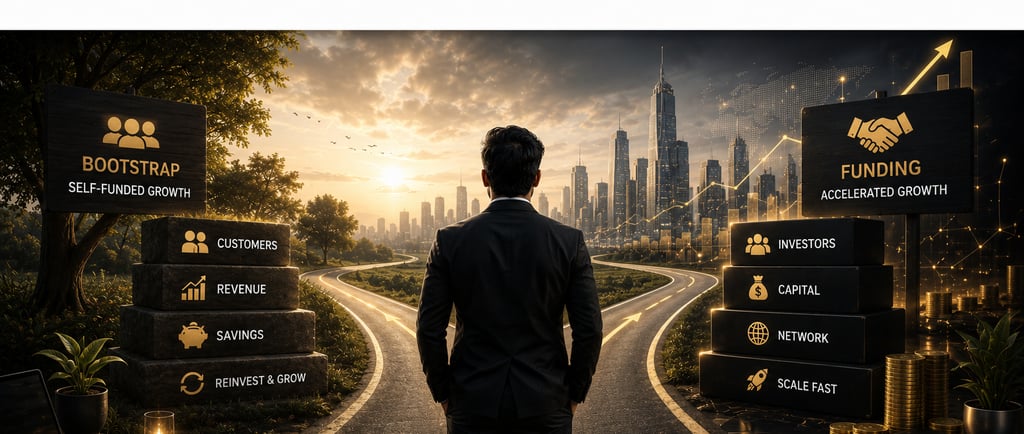

Every founder eventually faces one of the biggest decisions in entrepreneurship:
Should I build my business using my own money, or should I raise investment?
There isn't a universal answer.
Some of the world's most successful companies were built without outside funding for years, while others scaled rapidly with the support of investors.
The right decision depends on your business model, market opportunity, growth ambitions, and risk tolerance.
In this guide, we'll help you understand the differences between bootstrapping and funding so you can make an informed decision.
What is Bootstrapping?
Bootstrapping means building your business using your own resources.
Instead of raising money from investors, founders rely on:
Personal savings
Revenue generated from customers
Profits reinvested into growth
Small business loans (where appropriate)
Your customers become your primary source of growth capital.
Advantages of Bootstrapping
1. Complete Ownership
You don't give away equity.
Every decision remains under your control.
2. Customer-First Mindset
Without investor pressure, founders focus on creating products customers are willing to pay for.
Revenue becomes the primary growth engine.
3. Financial Discipline
Limited resources encourage smarter decisions.
Bootstrapped founders usually avoid unnecessary hiring, excessive marketing expenses, and feature overload.
4. Long-Term Flexibility
You decide:
When to grow
What to build
Which markets to enter
There is no external pressure to chase aggressive growth targets.
Challenges of Bootstrapping
Bootstrapping also comes with limitations.
Growth may be slower because:
Marketing budgets are limited
Hiring takes longer
Product development moves gradually
Cash flow must be managed carefully
Patience becomes one of your biggest competitive advantages.
What is Startup Funding?
Startup funding means raising capital from external investors.
Common funding sources include:
Friends and family
Angel investors
Venture capital firms
Accelerators
Strategic investors
In exchange, founders typically give up a percentage of ownership in the company.
Benefits of Raising Funding
Faster Growth
Funding allows startups to:
Hire talent
Build products faster
Expand into new markets
Increase marketing efforts
Scale operations
Speed can become a competitive advantage.
Access to Expertise
Many investors contribute more than capital.
They often provide:
Industry knowledge
Mentorship
Business connections
Hiring support
Partnership opportunities
The right investor can accelerate learning as well as growth.
Market Expansion
Investment makes it easier to enter multiple cities or countries without waiting for revenue to accumulate.
Challenges of Funding
Funding isn't free money.
Founders should consider:
Equity dilution
Board expectations
Growth pressure
Investor reporting
Potential loss of strategic flexibility
Choosing the wrong investor can create long-term challenges.
How to Decide?
Ask yourself these questions:
Do customers already pay for your solution?
If yes, bootstrapping may be a practical option.
Is speed critical?
If you're entering a highly competitive market where timing matters, funding may help you scale faster.
How much control do you want?
If maintaining ownership is a priority, bootstrapping offers greater independence.
Does your business require heavy upfront investment?
Businesses involving manufacturing, hardware, biotech, or deep technology often require significant capital before generating revenue.
Can You Combine Both?
Absolutely.
Many successful founders follow a hybrid approach:
Bootstrap until product-market fit.
Build consistent revenue.
Raise funding later to accelerate growth.
This often leads to stronger negotiating power because investors see real traction.
Common Founder Mistakes
Avoid these pitfalls:
Raising money before validating the product
Chasing funding instead of customers
Giving away too much equity too early
Assuming funding guarantees success
Ignoring profitability
Remember:
Funding amplifies a good business—it doesn't fix a weak one.
Final Thoughts
Both bootstrapping and funding can lead to successful businesses.
The best path depends on your goals—not someone else's success story.
If your business can grow through customer revenue, bootstrapping offers greater control and financial discipline.
If your opportunity demands rapid expansion and significant capital, strategic funding may be the right choice.
The smartest founders understand when to stay lean and when to accelerate.
Frequently Asked Questions
Is bootstrapping better than raising funding?
Neither option is universally better. The right choice depends on your business model, capital requirements, market competition, and long-term goals.
Can I raise funding after bootstrapping?
Yes. Many startups bootstrap during the early stages to validate their product and build revenue before approaching investors.
Do investors always take control of the company?
Not necessarily. Investors receive equity and may have governance rights, but founders often retain operational control depending on the investment terms.
Should first-time founders bootstrap?
For many service-based and software businesses, bootstrapping can be a practical way to validate demand before considering external investment.
The FOUNDERS First
Empowering founders with mentorship, strategic partnerships, investor access, and business growth support.
Home-For Founders-For Investors-About-Contact
Inquiries
Info@thefoundersfirst.in
Gurugram- Haryana, India
© 2026 The Founders First. All Rights Reserved. Made with ❤️ in India for Founders.
Building India's Next Generation of Startups